
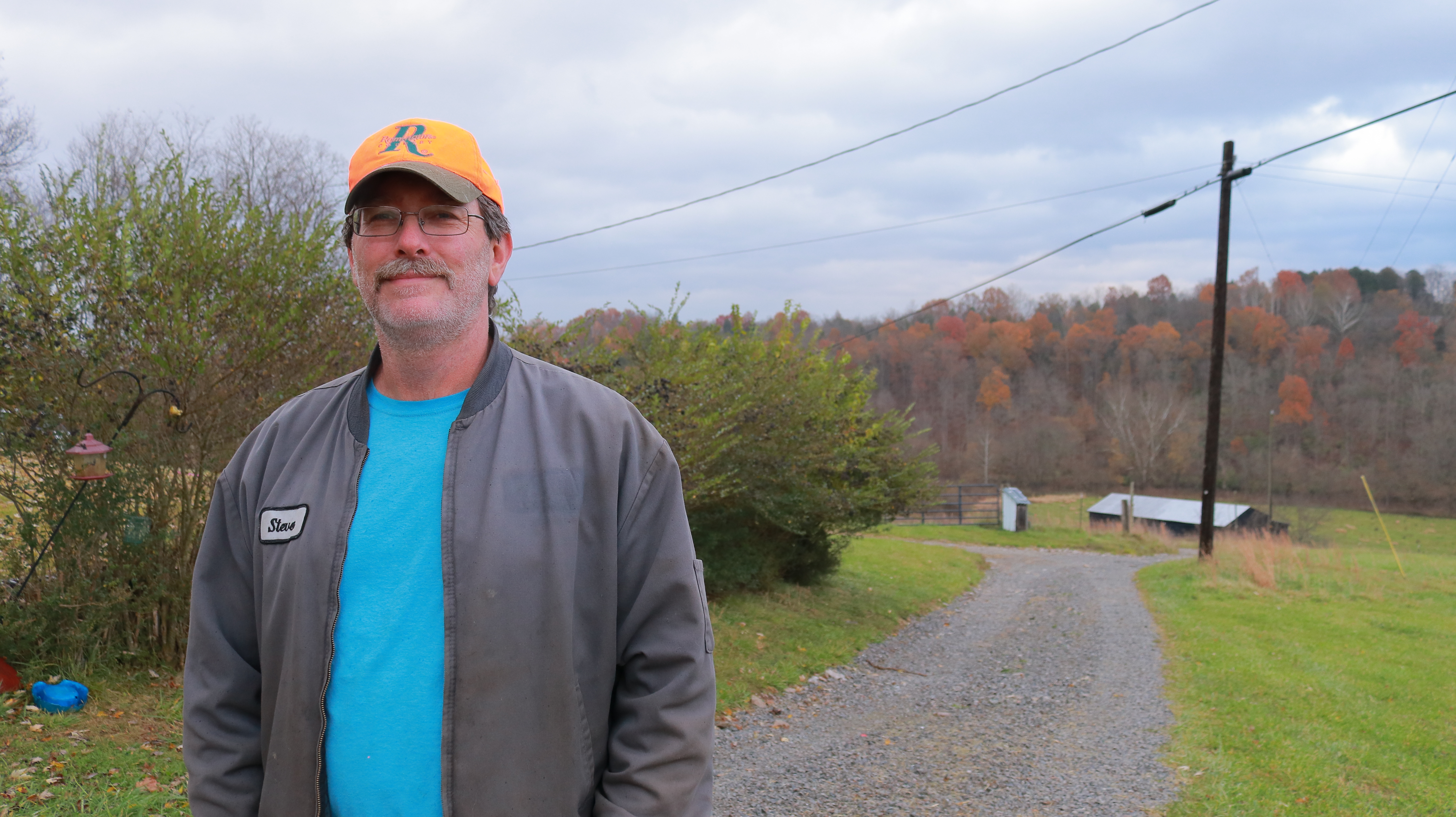
 Steven Wright was born and raised in Owen County and has never lived anywhere else — aside from his own farm.
Wright began his career in farming, but by the 1980s and 1990s, he had transitioned into machining, where he used lathes, mills, and computer-controlled equipment to repair or improve agricultural machinery. He later worked as a prototype machinist, where he designed and created custom one-off parts and tools when standard equipment couldn’t meet a specific need.
“My grandfather bought the farm that I’m on right now in the ’30s during the Depression,” Wright said. “He paid $3,000 for it.”
Wright was just 20 years old when his father died, and many details of his father’s life came from neighbors.
“My family is twisted and not traditional,” Wright said with a small chuckle. “My grandmother died when my dad was four. He really didn’t know her. He and she both had measles, and the only shot you had would either kill you or cure you. He survived; she died.”
Afterward, Wright’s great-grandparents, tenant farmers at the time, took care of his father while managing a 300-acre farm. Tragedy struck the family multiple times: his sister died in a farming accident in 1980, his brother died in a truck accident in Pennsylvania in 1989, and his father passed away from cancer in 1990. For Wright, death became a natural fact of life—not something to mourn or be afraid of.
“That’s the reason why I’m a little more laid back,” Wright said. “People get tore up over simple things, but this stuff usually works out.”
Wright says farm life is about balance. He treasures the quiet seclusion of his Owen County land, yet he’s quick to point out that farming is never done alone. Neighbors are lifelines, he says, recalling countless times when broken tractors or looming rain meant dropping everything to help one another. In his view, the close-knit community is as much a part of farming as the soil itself.
“I’m not as bad as Daniel Boone,” Wright said with a laugh. “There was a quote that he put out that he wanted to move because he could see the smoke from his neighbor’s chimney. I’m not that bad. What happens is you depend on your neighbors to help you.”
Wright’s farm is still dotted with tractors and equipment that haven’t been used in over 40 years, but he’s reluctant to let them go.
“My dad had to sell a lot of it off in the ’80s to pay off debt,” he said. “Back then—and still today—to put out a crop, especially tobacco, you had to borrow money. Fertilizer, equipment—everything was financed. You paid it back when you sold your crop in the winter. But if you had a bad year—a drought, for example—you couldn’t pay it back. And the loans would just keep piling up.”
Eventually, his father asked if the kids wanted to keep the farming tradition alive. Wright chose a different path.
“Farming is dying,” he said. The family sold 200 acres to pay off loans and kept the remaining land.
He notes how schools and government policies steered young people away from farming and the skilled trades, even as demand for those jobs remained high. For Steven, this trend reflects a disconnect—while farming may be tough in his region, both agriculture and trades are vital to sustaining rural communities and families like his own.
Now, his daughter is poised to become the fifth generation to inherit the property.
“My wife and I borrowed money to build on the farm and pay off existing debt,” Wright said. “We even borrowed to buy the house. But we’re almost paid off now. That way, my daughter won’t have to worry about it.”
Wright said it doesn’t matter whether she farms the land — only that she keeps it.
 “There’s only one thing they’re not making more of, and that’s land,” he said. “In my lifetime, I’ve seen it go from cheap to outrageous. And you can’t live on it as a farmer. You can’t make enough money on this ground to pay for it. You’re working somewhere else just to support your farming habit.”
As for the daily life of a farmer?
“Your day never really ends,” Wright said.
He also spoke about the importance of community in rural areas like Owenton.
“This has always been a close-knit community,” he said. “If you didn’t know something, you’d go to your neighbor. Your neighbor is your lifeline. If your tractor breaks down, what are you going to do? You call someone to help you.”
Wright reflected on the challenges of farming in his region, where poor soil, limited infrastructure, and changing markets make traditional crops difficult to sustain. He’s seen innovative ideas, from hemp to ostrich, struggle without the right support or buyers. He lamented the loss of once-thriving farms that have now been abandoned or turned into hunting grounds.
“I’ve watched it since I was a kid. Farms used to be clean, with cattle and tobacco,” he said. “Now, they’re overgrown and used for hunting. Nobody’s working them anymore.”
Today, the largest active farm nearby runs 200 acres of cattle. Many former farmers have retired, and others lease land to hunters just to cover expenses, including rising property taxes tied to farm valuations.
“Like I said,” Wright repeated, “you work to supply your farming habit.”
 KY Place